Megan WarrenMath Books

Free to read · No account · No install

Math books by Megan

All free to read and use.

Four course textbooks and their history companions.
Written, designed and built by Megan.
Each one opens in a browser, keeps working with the wifi off, and is also free on Apple Books.

7free books
264sections in all
49,643math expressions, every one with a spoken label
48interactive widgets, one per teaching section

Two ways to read any of them

The same book, in two places, both free

Each one does something the other cannot, so this is a real choice rather than a fallback.

In your browser

The interactive widgets and the Ask the TA chat run here, and nowhere else. Nothing to install, and no network needed once the page has loaded.

On Apple Books

Yours to keep, with no copy protection. On an iPhone, iPad or Mac you can highlight, take notes and bookmark as you read, which a web page cannot do. The interactive widgets arrive as pictures, each one linking back to the live version.

Start here

Pick your course

Four courses, each one opening straight into the book. The history companion that goes with yours is a little further down the page.

1 course textbook and 1 companion reader

Trigonometry

One course, and the story of where it came from.

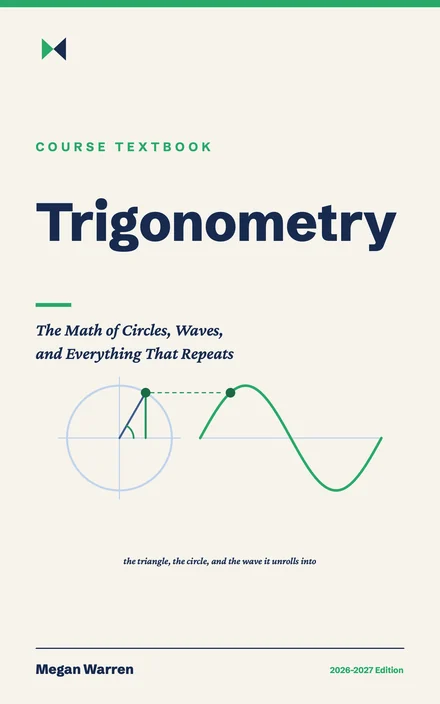
Cover of Trigonometry: The Math of Circles, Waves, and Everything That Repeats, by Megan Warren.

Course Textbook

Trigonometry

The Math of Circles, Waves, and Everything That Repeats

The three ideas behind everything that repeats: the triangle, the circle, and the wave it unrolls into.

Trigonometry starts with a triangle you can measure and ends with a wave that repeats forever. This textbook walks that whole path in four units: Triangle Geometry, The Unit Circle, Periodic Functions, and Solving Trig Equations.

  • 47 sections
  • 12 interactive widgets
  • 606 hints
  • 378 worked solutions

Read it in your browser

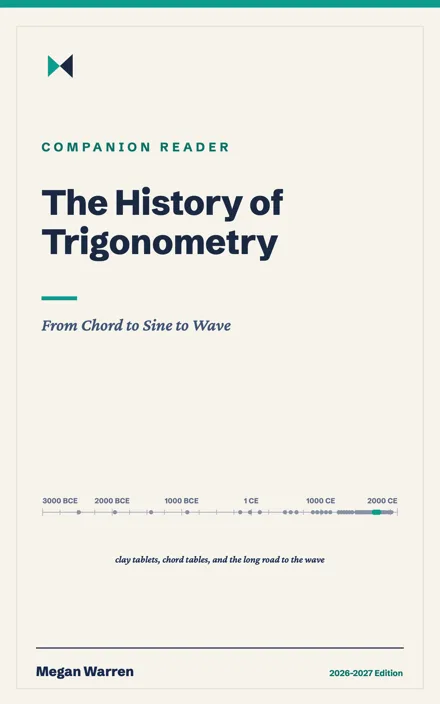
Cover of The History of Trigonometry: From Chord to Sine to Wave, by Megan Warren.

Companion Reader

The History of Trigonometry

From Chord to Sine to Wave

Trigonometry was not invented. It was converted, three times over, by people who each wanted something different from it.

Trigonometry did not begin as the subject you were taught. It began as a table of chords, built so astronomers could say where a planet would be. This is the story of how that table became the sine, and how the sine became the wave.

  • 8 chapters
  • 260 dated events
  • 11 appendices and a glossary
  • 4,098 source pointers

Read it in your browser

2 course textbooks and 1 companion reader

Calculus

Two courses, a two-volume pair, and one history that covers both.

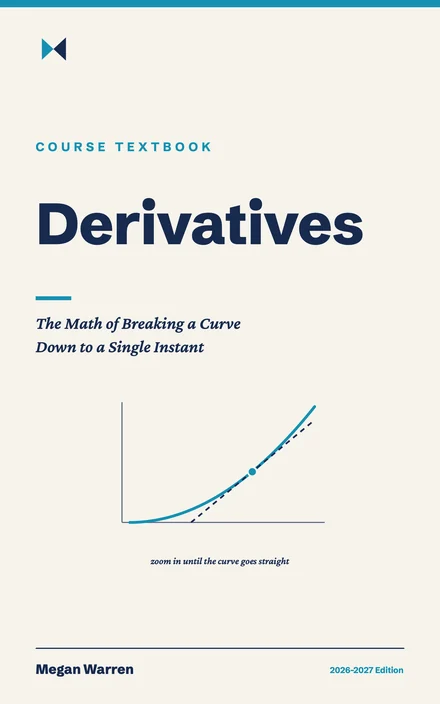
Cover of Derivatives: The Math of Breaking a Curve Down to a Single Instant, by Megan Warren.

Course Textbook

Derivatives

The Math of Breaking a Curve Down to a Single Instant

The three ideas behind every exact slope: the secant line, the tangent line, and the limit that closes the gap between them.

A derivative is a rate of change: how fast something moves at one instant, not averaged over a stretch. This course textbook builds that idea from the ground up, then makes it routine, then puts it to work.

  • 43 sections
  • 12 interactive widgets
  • 566 hints
  • 354 worked solutions

Read it in your browser

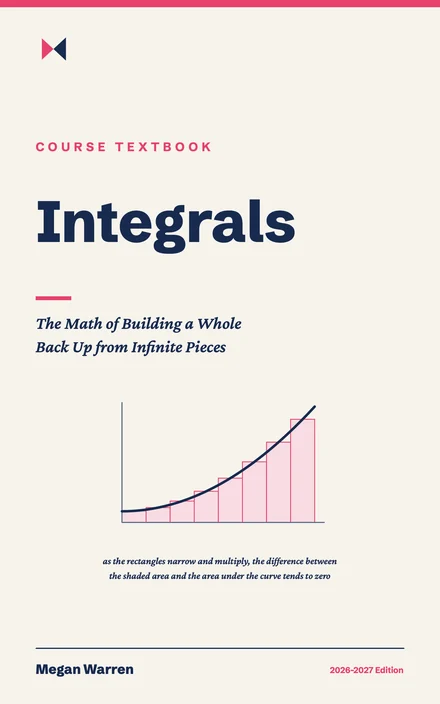
Cover of Integrals: The Math of Building a Whole Back Up from Infinite Pieces, by Megan Warren.

Course Textbook

Integrals

The Math of Building a Whole Back Up from Infinite Pieces

The three ideas behind every exact amount: the rectangles, the area under the curve, and the limit that closes the gap between them.

An integral builds a whole back up out of infinitely many pieces. This course textbook starts with rectangles under a curve and does not stop until that one idea is computing volumes, arc lengths, work, and probability.

  • 42 sections
  • 12 interactive widgets
  • 546 hints
  • 342 worked solutions

Read it in your browser Web edition only, for now

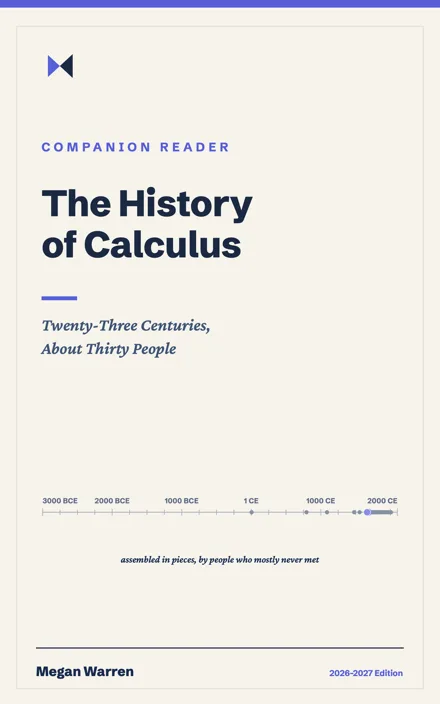
Cover of The History of Calculus: Twenty-Three Centuries, About Thirty People, by Megan Warren.

Companion Reader

The History of Calculus

Twenty-Three Centuries, About Thirty People

Calculus was not invented in a single year by a single genius. It was assembled, in pieces, by people who mostly never met, and two of them got their names on it.

Most textbooks give the history two sentences. Newton and Leibniz invented calculus, they had a fight about it, now here is the power rule. Both sentences are true and both are badly misleading. The tangent problem and the area problem had been worked on for roughly two thousand years before either man was born.

  • 12 chapters
  • 340 dated events
  • 11 appendices and a glossary
  • Companion to both calculus courses

Read it in your browser

1 course textbook and 1 companion reader

Discrete Math and Linear Algebra

The math machine learning runs on, and the twenty-five centuries behind it.

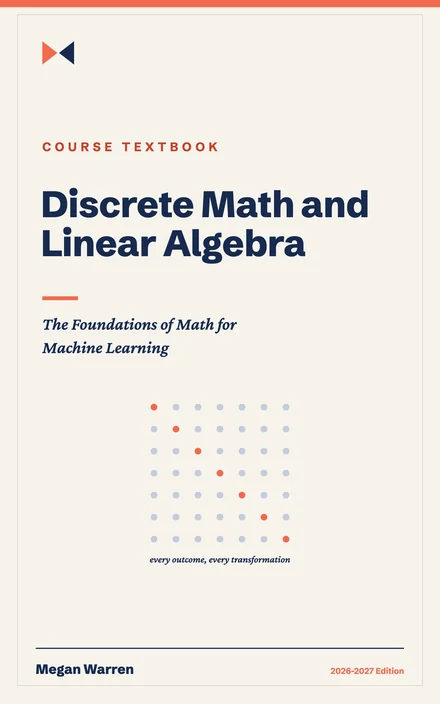
Cover of Discrete Math and Linear Algebra: The Foundations of Math for Machine Learning, by Megan Warren.

Course Textbook

Discrete Math and Linear Algebra

The Foundations of Math for Machine Learning

The three ideas a machine needs to learn: uncertainty, representation, and change over time.

Discrete Math and Linear Algebra starts with counting the ways something can happen and ends with a matrix that predicts where a system settles. Four units: Intro to Probability, (Not So Simple) Probability, Matrix Theory, and Markov Chains.

  • 44 sections
  • 12 interactive widgets
  • 565 hints
  • 340 worked solutions

Read it in your browser

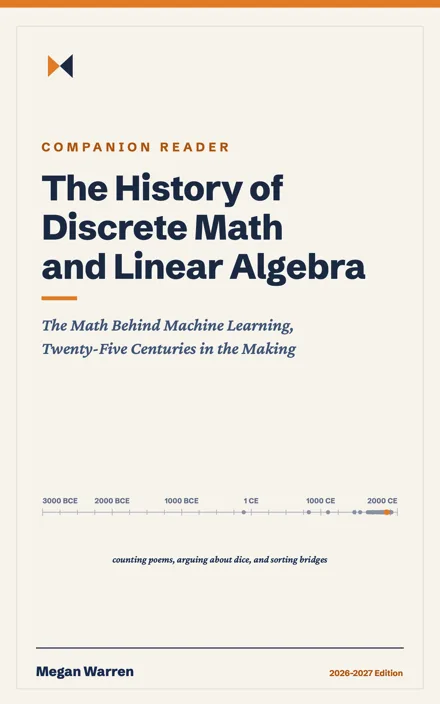
Cover of The History of Discrete Math and Linear Algebra: The Math Behind Machine Learning, Twenty-Five Centuries in the Making, by Megan Warren.

Companion Reader

The History of Discrete Math and Linear Algebra

The Math Behind Machine Learning, Twenty-Five Centuries in the Making

Almost nobody in this story was building the mathematics your course teaches. They were counting poems, arguing about dice, sorting bridges, and trying to win a fight about free will.

Pingala was counting the rhythms of Sanskrit poetry. Cardano was trying to win at dice. A clerk in Han China was dividing up bundles of rice on a ruled board and doing Gaussian elimination two thousand years before it had that name. This is where the mathematics behind machine learning actually came from.

  • 9 chapters
  • 583 dated events
  • 11 appendices and a glossary
  • 4,239 source pointers

Read it in your browser

True of every book here

What they all have in common

These are not seven separate projects. They share one chassis, one type scale, one set of rules about how mathematics gets written down, and one standard for who can read them.

It is one file, and it works with the wifi off

Every book is a single HTML page. After it loads it makes no network calls, so it keeps working on a plane, on a locked-down school network, or with no signal. No install, no account, no app, nothing to update.

Every formula is written to be heard

All 49,643 mathematical expressions across the seven books carry a spoken-English label. A screen reader reads a formula as a sentence instead of spelling it out symbol by symbol. Not one of them is unlabelled.

The maths is typeset properly

Fractions stack as a real numerator over a denominator, exponents are true superscripts, and worked solutions run vertically with the equals signs lined up, the way you would write them on the board.

Practice you can climb into

The four course textbooks carry hints you open one at a time when you are stuck, and fully worked solutions for when you want to check the whole chain. Between them they hold 48 interactive widgets, one per teaching section, that you can actually pull on.

The history books show their work

Every factual sentence carries a pointer to the source it came from. Where the sources genuinely disagree, the book says so on the page and leaves the disagreement standing rather than quietly picking a winner.

Readable in the dark, and at any size

Every book ships a day palette and a night palette, both audited to WCAG AA, plus a text-size control that goes up four steps. This page follows whichever your device is set to.

Before you ask

Questions worth answering up front

Are the books really free?

Yes. All seven are free to read on the web, and the Apple Books editions are free downloads with no copy protection. There is nothing to buy, nothing to subscribe to, and no upsell.

Do I need an account or a login?

No. There is no account, no sign-up, no email wall, and no install. Open the link and read.

Do they work offline?

Yes. Each book is a single HTML file. Once the page has loaded it makes no network calls at all, so it keeps working on a plane, on a school network that blocks half the internet, or with the wifi off. It is a big file for the same reason, so give it a moment on a slow connection.

Can I use these with my class?

Yes, and you are welcome to. Teachers can link to them, assign them, and read them with students. Each course book also has a teacher solutions key and a Lesson Studio behind a password; ask Megan for access.

What is the difference between the web edition and the Apple Books edition?

The web edition runs the interactive widgets and the Ask the TA chat, which cannot exist in an ebook. The Apple Books edition can be highlighted, annotated and bookmarked on an iPhone, iPad or Mac, which the web page cannot do. Same book, same words. Pick whichever suits how you read.

Which books are on Apple Books so far?

Trigonometry, The History of Trigonometry, Derivatives, The History of Calculus, Discrete Math and Linear Algebra, and The History of Discrete Math and Linear Algebra. The last one, Integrals, is not on the store yet. This page updates when each one lands.

Are they accessible?

That is the part that got the most work. Across the seven books, all 49,643 mathematical expressions carry a spoken-English label, so a screen reader says "one half" instead of spelling out a fraction symbol by symbol. Text is selectable and resizable, navigation is structural, diagrams carry written descriptions, and colour contrast meets WCAG AA in both the light and the dark palette.

Who wrote them?

Megan Warren, a mathematics teacher and tutor of twelve years in Boston, Massachusetts. She wrote, designed, built and typeset every one of them.
For teachers and teams

Want one of these for your own course?

These were built on an engine that forks one source into a student edition and a facilitator answer-key edition, so the two can never drift apart. The same engine handles a certification study guide, a corporate onboarding guide, or a training manual.

Commission an interactive textbook like these